Free · 6 minutes

Serve more. Same budget.

You're already paying for capacity you never receive. Six minutes will show you where it's going — and whether this organization could carry what it's praying for.

Free. No pitch. You keep the plan either way.

6
Minutes to a plan
19
Layers measured
0
Cost to start
What leaders ask us

Three questions. One cause.

Nearly every leader we meet asks some version of these. They're treated as three separate problems, and they almost never are.

01
"We need more capacity, but we can't afford to hire."

You're paying for capacity you're not getting.

Before you add people, look at where your team's hours already go. In most organizations a large share disappears into work that's duplicated, unassigned, or no longer connected to anything. That time is already funded. It's just not reaching the mission.

02
"Everything takes too long and I'm in every decision."

The problem is usually clarity, not effort.

When nobody knows who decides what, the organization compensates with meetings, extra approvals, and rework. Your team isn't slow. They're waiting — for you, or for permission nobody has written down.

03
"We need more donors."

Start with the ones you already had.

Sector-wide, roughly 43% of donors give again the following year. Most leave because nothing ever showed them what their gift did — not because they stopped caring. Keeping donors costs far less than replacing them, and it's usually the faster money.

All three trace back to the same place: how the organization is built. Which is why more money rarely fixes any of them.

The Avoidance Tax™

The bill you're already paying.

Every decision nobody makes. Every conversation nobody has. Every role nobody defines. It never shows up as a line item — it shows up as exhaustion, flat revenue, and capacity you can't use.

It is charged in weeks, not dollars. The staff member everyone works around. The program that should have ended two years ago. The role written so vaguely that three people half-own it and none of them decide.
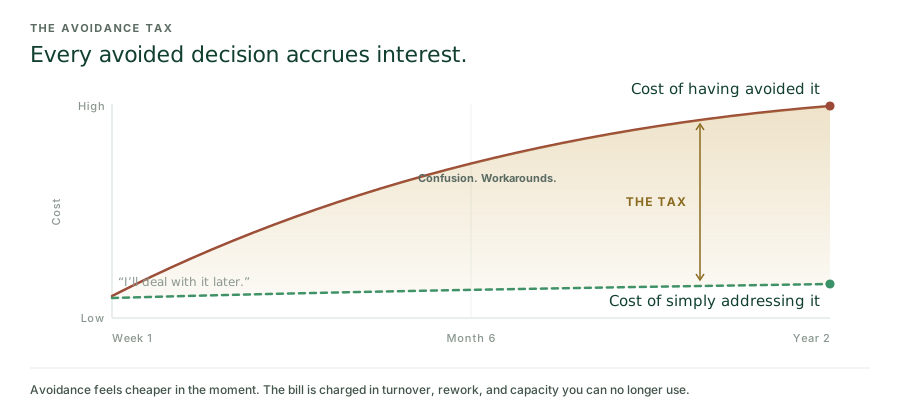
The Avoidance Tax: the cost of addressing something stays flat while the cost of having avoided it compounds, and the widening gap between them is the tax
Avoidance feels cheaper in the moment. The bill always comes due.

Here is why it goes unaddressed for so long: avoidance looks like patience. Waiting looks like wisdom. Not forcing the issue looks like grace. Most of it is fear wearing better clothes — and every month it goes unpaid, the interest compounds into something structural.

The term comes from Jesse Martin's book The Hidden Cost of Leadership. It is the one cost of leading that never appears on a budget and shapes everything on it.


Take the Flourishing Index Read the first chapter free →
Jesse Martin, Founder of The Growth Group
Who you'd be working with

Jesse Martin

Rev. Jesse Martin, M.A. · Founder

CEO of an international organization serving vulnerable children across seven African countries — 43 care points, operations in fourteen nations. Ordained minister, former pastor and church planter. Previously Chief Operating Officer of an organization working in more than 120 countries. M.A. in International Development; doctoral work in organizational leadership and management. Author of The Hidden Cost of Leadership.

We ran this on our own organization before we ran it on anyone else. That part wasn't comfortable.

More about the team → Read the book →

My concern is the small ministry with no name recognition, working in hard places without the systems larger organizations take for granted. For three of them a year, we do this for free — the full diagnostic and twelve months of work, at no cost.

The Prepared Cohort →

Your organization, in six layers

You already have a framework. Nobody's shown it to you.

Every organization runs on these six layers whether or not anyone has named them. When one is weak, the ones above it strain — and the strain shows up somewhere that looks unrelated. We measure all six, then bring the practitioner who matches what's actually broken.

The Flourishing Framework: six layers from Vision Core through Continuous Improvement
The Flourishing Framework™ — the six layers your free Index scores.

Which is why the work runs in this order, every time:

01 · Measure

Six minutes, six layers, free. You find out which constraint is producing the others instead of guessing.

02 · Understand

A free working session on what the results mean — where your leaders disagree, and what to move first.

03 · Fix, then prove it

We build what the diagnostic says is missing, in sequence — then you re-measure against your own baseline.

What we are actually afraid of

The increase comes,
and you cannot carry it.

Most leaders brace for drought. Drought is survivable — you cut, you wait, you hold on. What breaks organizations is the harvest they were not built to hold.

  • The funding arrives and the systems buckle underneath it.
  • Doors open in a new region and there is nobody ready to send.
  • A donor says yes to something bigger, and your reporting cannot substantiate it.
  • The work grows, and the people who built it break carrying it.
  • You spend years praying for growth, and it becomes the thing that damages what you made.

Six minutes tells you whether this organization is ready.

What changes for you

Built to carry what God sends.

Before and after comparison across capacity, decisions, priorities, funding and impact
Measured against your own baseline at six and twelve months.

Four to six priorities with owners instead of twenty. Decisions made at the right level, so your desk stops being the queue. Funding that grows with capacity rather than capping it. And impact you can prove to a board rather than describe.

Underneath all of it: an organization that could survive your absence, which is the only definition of success that lasts.

For organizations

Find the constraint limiting your next stage.

Six minutes, free, and you keep the plan whether or not we ever speak.

Take the Flourishing Index

Funder, network or prime partner? Start here instead →