They tell you about vision and influence. They hand you the title, the budget, and the org chart. They don't tell you that the hardness will change you — one small surrender at a time.
Leadership is stewardship under pressure — carrying responsibility for people, mission, money, and outcomes without letting the weight make you controlling, avoidant, harsh, or self-protective.
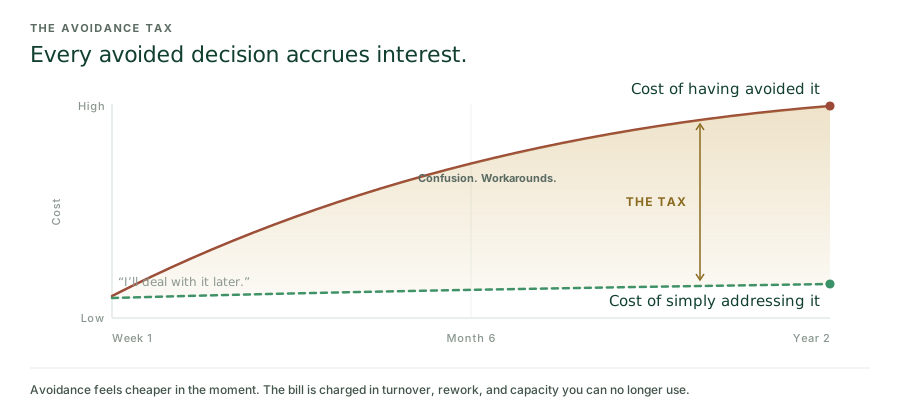
Under pressure, leaders drift toward control instead of trust, avoidance instead of truth, image management instead of honesty. Nobody sets out to become a guarded, cynical leader. It happens quietly.
The leaders who endure aren't the ones who avoid the cost. They're the ones who understand what it is and pay it wisely.
From Chapter 14 — The Cost of Ambition.
I was twenty-six years old. I had ten staff reporting to me and a forty-five-thousand-square-foot campus to keep running, and on Sunday mornings I stood on a stage in front of somewhere between twelve and eighteen hundred people, depending on the week. My job that morning was the welcome. Ninety seconds.
Two friends of mine walked into the lobby while I was talking. They were not church people — that was most of why I loved them. The lobby had televisions mounted on the walls so people arriving late could see what they were missing. My friends came through the doors, looked up, and saw my face on four screens at once.
They found me afterward, grinning, entirely unaware they were handing me anything.
"Dude. You're on TV. You're famous."
They meant it as a joke. It landed as something else.
Something inside me lit up — a small, warm, immediate pleasure at being seen. It did not feel like temptation. Temptation announces itself. This felt like being fed something I had not known I was hungry for.
And at the same instant, something else in me recoiled. Not at my friends. At myself. At whatever it was in me that had just enjoyed that so much and so fast.
I stood in a church lobby holding both feelings at once: a hunger I did not want to admit, and a revulsion at finding it there.
That morning was the beginning of the end of my ability to pretend the cost of public leadership was not real.
Henri Nouwen named this decades ago: the temptation to be relevant, to be spectacular, to be powerful. His observation is the one the book keeps returning to — being relevant, popular, and powerful are not vocations. They are temptations. Every leader I know has quietly reclassified at least one of the three as a calling.
Henri J. M. Nouwen, In the Name of Jesus: Reflections on Christian Leadership (Crossroad, 1989).
This isn't a book about leadership in general. It's for a specific person, in a specific season.
You're respected, you're producing, and you're privately not sure how much longer you can hold this. Saying so feels like betraying people who believe in you.
The seat, the growth, the influence. It arrived, and something you didn't expect came with it. Nobody warned you about this part.
You've watched leaders go hard to survive the job. You don't want that. You want to know whether it's possible to carry this and stay soft.
Four parts: the seat, the people, the organization, the interior life.
The book isn't finished yet. Put your name down and I'll send you the opening chapter today — then a note when it's ready, and nothing else in between.
I've spent twenty years in seats that looked, from the outside, like the thing I'd been working toward. Some of them were. All of them cost something I hadn't been warned about — and I kept meeting leaders paying the same bill in private, convinced they were the only one.
This is the book I needed at twenty-six, standing in an empty lobby wondering what I'd gotten myself into. It doesn't tell you the cost isn't real. It tells you what it is, what it's for, and how not to let it make you into someone you didn't intend to become.
If the organizational side of this is what's weighing on you, the Flourishing Index measures it in six minutes. But that's a different conversation than this one.
“The seat is an assignment, not a possession.”