Every international organization says it believes in local leadership. Far fewer can tell you the ratio of nationals to internationals in the room where decisions actually get made. The gap between those two facts is where most development work goes wrong.
The principle
Those closest to the problem should solve it — or at minimum hold the loudest voice in the room where it gets solved. This is not sentiment. It is an accuracy argument. A Ugandan program director understands what will actually work in a Ugandan community in ways no visiting expatriate can, no matter how credentialed, well-intentioned, or long-serving.
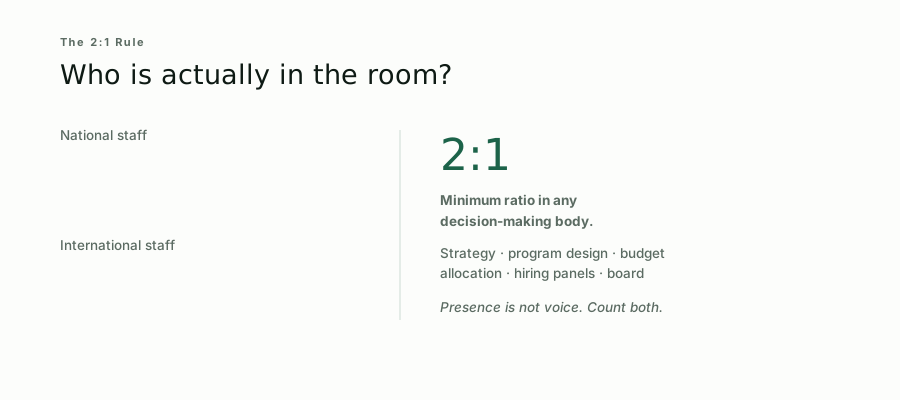
The working standard we use: in any decision-making body of an international organization — strategy sessions, program design, budget allocation, hiring panels — national staff should outnumber international staff by at least two to one.
This is our practice standard rather than a sector regulation. But it operationalizes something the sector has committed to in principle and largely failed to deliver in practice.
What the sector actually committed to
The 2016 Grand Bargain committed signatories to channel at least 25% of humanitarian funding to local and national actors as directly as possible.1 Nearly a decade later, progress remains slow and uneven: in 2023, 58% of funding from signatory donors still went to multilateral institutions and 23% to international NGOs.2 Only a handful of donors and fifteen aid organizations reported meeting the target.3
Money is the visible half of localization. The invisible half — and in our experience the more determinative one — is who decides. An organization can move funding to national entities while keeping every meaningful decision in a headquarters five thousand miles away. That is subcontracting, not localization.
Why the ratio matters more than the policy
Most international organizations have a localization policy. Very few have a localization arithmetic. Here is what changes when you count:
| What you'll find | What it means |
|---|---|
| Nationals present but silent | Presence isn't voice. If they speak less than a third of the time, the ratio is cosmetic. |
| Nationals in delivery roles, internationals in design roles | The classic pattern. Locals implement decisions they did not shape. |
| The "advisory" workaround | National input gathered, then decided elsewhere. Consultation is not ownership. |
| English-only meetings at pace | Language fluency becomes a proxy for authority. Slow the room down. |
How to implement it
1. Count, publicly
List every body where decisions are made: executive team, program design, budget approval, hiring panels, board. Record the national-to-international ratio for each. Publish it internally. The counting alone changes behavior.
2. Fix composition before fixing process
Facilitation techniques won't rescue a room that is structurally seven internationals and two nationals. Change who is in the room first.
3. Move decision rights, not just seats
Use your decision-rights matrix to name what is genuinely local. A useful default: outcomes and non-negotiables are global; methods are local. Headquarters owns what and why. National teams own how.
4. Build the pipeline you claim to want
Organizations that cannot find qualified national leaders have usually not invested in developing them. Competency frameworks, mentoring, budgeted development, and genuine succession planning are what make the ratio achievable rather than aspirational.
5. Pay properly
Nothing exposes a stated commitment to local leadership faster than a salary structure where an international coordinator earns several times a national director. If you cannot defend the gap out loud to both parties, it is not defensible.
The objections, answered honestly
- "We can't find qualified nationals." Sometimes true in a specific technical role. Usually it means the pipeline was never built. Treat it as a five-year development problem rather than a permanent condition.
- "Donors want international oversight." Some do. Increasingly, sophisticated funders want the opposite and will ask you for your localization metrics. Get ahead of it.
- "Our national leaders have less experience." Frequently true — because they were never given the roles that build it. Experience is an output of opportunity.
- "It slows decisions down." Occasionally. It also stops you spending three years on a program design that a local leader could have told you would fail in week one.
The uncomfortable test. If every international staff member left your country programs tomorrow, what would happen? If the honest answer is collapse, you have built dependency — regardless of what your strategy document says. The goal of good international work is to become unnecessary.
Your first 90 days
- Count the ratio in every decision-making body. Write the numbers down.
- Name the three decisions currently made internationally that should be local.
- Move those decision rights in writing, with a date.
- Identify two national leaders ready for expanded authority and fund their development.
- Report the ratio to your board quarterly, alongside your financials.
Where this sits. Local Ownership work only holds when the layer beneath it is solid. The free Flourishing Index shows you which layer is actually constraining you — in six minutes. Take the Index →
- Grand Bargain Localisation Workstream, Inter-Agency Standing Committee — the 25% direct funding commitment.
- Development Initiatives — Funding to local and national actors, 2023 funding distribution analysis.
- Highlights of the 2024 Grand Bargain Self-Reporting Cycle (ReliefWeb).
- The 2:1 ratio is The Growth Group's practice standard, not a sector regulation. We publish it as a working threshold and welcome challenge to it.